
PFinsights #33: Society in the Mirror: Is it care or obsession?

PFinsights #33: Society in the Mirror: Is it care or obsession?
'Looking good means feeling good'. This phrase encapsulates an increasingly prevalent reality in our society. Personal care has ceased to be a one-off gesture and has become an established habit that cuts across age and gender. It is also having an increasingly significant impact on perceptions of well-being and happiness.
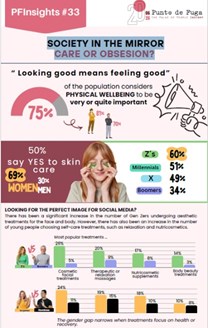
According to data from our new PFInsights #33 report, 75% of people in Spain say they attach great or considerable importance to physical care. This confirms that self-care has become an established social norm rather than just a passing trend. Furthermore, we can observe the broadening scope of the culture of self-care. Skincare is becoming the norm; half the population say they undergo aesthetic facial treatments, with a higher prevalence among women (two in three women use them). Other types of treatment are also emerging, including aesthetic facial and body treatments, therapeutic or relaxation massages, and nutricosmetic supplements. This shows that skincare is not just about aesthetics, but also about prevention, therapy, and holistic wellbeing.
Aesthetic care remains more prevalent among women, particularly for body and facial treatments. However, when treatments focus on health or recovery, the gender gap narrows significantly, and self-care is no longer exclusively a female domain. It is therefore being redefined as a shared territory, bringing the behaviours of men and women closer together.
Generation Z: between self-care and aesthetic pressure
If there is one group in which this phenomenon is intensifying, it is among the youngest: Generation Z has shown a significant increase in the uptake of both facial and body aesthetic treatments. They also lead the way in consuming treatments associated with health and wellbeing, such as relaxation and nutricosmetics.
The situation is not straightforward. We are talking about a generation that cares about its image yet also considers well-being to be an integral part of its identity.
However, a significant tension is emerging. The importance of 'feeling attractive' in relation to happiness is particularly high among young people. For some, looking good influences not only their well-being, but also their perception of happiness. According to data from the Spanish Society of Aesthetic Medicine (SEME), the average age of people undergoing their first cosmetic surgery procedure has fallen from 35 to 20. This change is evident, showing how the pressure to look good is starting earlier and intensifying.
Self-care is positive, necessary and healthy. However, when a positive self-image becomes a prerequisite for happiness, the distinction between well-being and social pressure can become blurred.
Society is holding up a mirror to itself.
The issue is whether it is self-care or self-imposed pressure.


