
PFinsights #30: Spain loves cooking… yet hates deciding what to eat

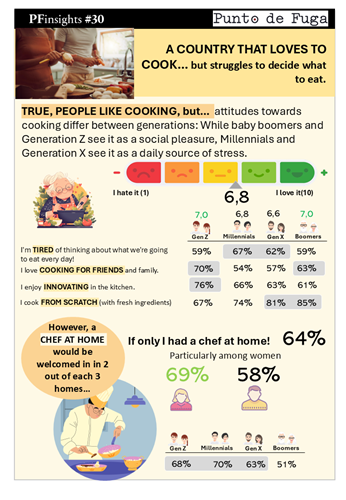
Cooking has become one of those topics that people of all generations think they understand each other on… until we look at the data. It's true that we like cooking: the act, the aromas, the creativity and the sharing (it scores 6,8 out of 10). But it also weighs on us. It tires us. It demands that we think. In 2025, the kitchen is an emotionally charged space.
And that is precisely what our latest infographic reveals.
Spain loves cooking… yet hates deciding what to eat
When asked about enjoyment, we see that Spaniards love cooking for friends and family. The scene is almost cinematic: a house full of people, a long table and that special recipe which only makes an appearance on special occasions.
But when shifting the focus slightly, the picture changes completely: the daily struggle of deciding “what shall we eat today” turns in the foreground and shows to be very real as well. That’s why we recognise that the kitchen is a place of contrasts: cooking brings joy, while planning can be exhausting. The dichotomy is clear.
The different generations experience the kitchen from different perspectives
Behind this tension lie clear generational patterns:
- Boomers and Generation Z tend to view the kitchen more as a place for enjoyment. They see it as a social space where they have the time and inclination to spend time at the stove.
- Generation X and Millennials, on the other hand, feel the daily burden more keenly. They are the ones living with faster-paced lives, split schedules and less mental bandwidth.
It is this combination—little time, many demands—that turns the kitchen into a territory where pleasure and obligation compete every day.
The collective dream: having a private chef at home
Perhaps that is why 2 out of 3 Spaniards would like to have their own chef. We are not talking about an aspirational luxury, but an emotional desire: someone who takes away the repetitive parts of the task, leaving us only with the enjoyable ones.
Among women, the desire is even stronger: as many as 69% admit they would sign up for it without hesitation. A figure that speaks not only of culinary tastes, but of how tasks are still distributed in many households.
Generation Z is rediscovering the love of cooking
And while this is happening, Generation Z is breaking the mould. They aren't rejecting cooking; they're reinventing it.
They cook more by improvising and embracing modern cuisine, approaching cooking from a different angle: less formality, more freshness. Where others see routine, they see a space to improvise. Whereas in the past people would look to cookbooks or TV programmes for inspiration, now they look to their mobile phones.
Social media is now the main source of culinary inspiration for all generations, including a third of boomers, but for Gen Z social media is the kitchen: 20-second tutorials, three-ingredient recipes, visual hacks, dishes that ‘look good on camera’. Inspiration no longer comes from the cookbook - all stems from the feed.
Their preference for the modern cuisine (40%, compared to 21% for the traditional) and their inclination towards improvisation (45%) mean that their approach to cooking is not inherited, but reinterpreted. A kitchen that adapts to the rhythm of their lives, not the other way round.
Homes without kitchens? The question is already on the table
These figures open up a thought-provoking prospect: if cooking is enjoyed more when it isn’t compulsory…
what would happen to a kitchen designed solely for when the mood takes you?
Smaller spaces? Modular kitchens? Appliances that disappear?
The idea, which seemed futuristic years ago, is now met with less resistance than ever. The kitchen is transforming into a flexible, optional, emotional space, deeply influenced by the digital world.
The full infographic: a generational perspective on an everyday activity
Our new infographic explores the paradox of how an everyday act like cooking can mean different things to different people, depending on factors such as the time they have available, the inspiration they follow and the pressures they face in their daily lives.
It is an in-depth analysis that ultimately shows that we enjoy cooking, provided it is not obligatory.
👉 Discover the full infographic and all the data here


