
PFinsights #32: New Year’s resolution? Looking after my wellbeing

January always arrives with the same ritual: brand-new diaries, gym memberships, lists of “this year I really will…” and that collective feeling that change is just a decision away. But when we look at the data—unvarnished and unfiltered—what emerges is not so much a country full of plans, but a country full of intention.
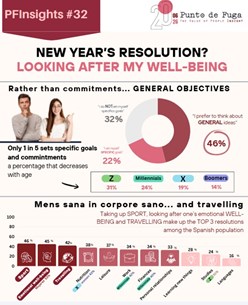
Because in Spain, rather than “resolutions”, what abounds are good ideas: 46% admit they have “general ideas” about what they want for the year; 32% simply don’t set themselves any goals; and only 22% say they set specific goals.
The picture that emerges is not one of an unmotivated society. It is, rather, one of a weary society. And that changes everything: we are not giving up on improving, but we are renegotiating the effort we are willing to sustain over time.
Furthermore, the relationship with purpose is not the same for everyone:
- Boomers: they are the ones who set the fewest goals (in their case, the “I don’t set goals” figure rises to 53%).
- Generation Z: they are the ones most likely to say they set specific goals (rising to 31% compared to the overall 22%).
An interesting insight: younger people aim higher… but they also come up against the realities of daily life sooner.
What do we set out to do? The shift towards the experiential
If there was a time when the New Year was filled with ‘material’ goals (buying, owning, accumulating), today the rankings tell a different story: what we seek most is to feel better and live more fully.
The top 3 resolutions in Spain are clear:
- Taking up sport (46%)
- Looking after emotional wellbeing (45%)
- Travelling / seeing the world (42%)
It’s no small thing: sport + emotional health + experiences. In other words, body, mind and horizons.
And when we look at the details, equally revealing nuances emerge:
- Emotional wellbeing is particularly important among women (53%).
- Education (24% overall) soars to 51% among Gen Z: for them, the future is not an abstract desire; it is a practical concern.
- Work (34%) and personal finances (34%) are gaining traction among millennials (40% and 42% respectively).
Consumers are shifting from ‘having’ to ‘being’. Less aspirational promise and more need for balance.
We say yes… but we only half-commit
The most human insight in the entire infographic is not what we wish for, but what we actually manage to sustain.
- 38% usually achieve half (50%) of their goals.
- 33% reach 75%.
- Only 6% achieve 100%.
- And 10% achieve none at all.
And once again, we find generational differences:
- Boomers appear to be the least likely to meet their targets (19%).
- Those most likely to reach 100% are men (9%) and Gen Z (14%), above the overall 6%.
Not necessarily because they have more ‘willpower’, but because sometimes success doesn’t depend solely on wanting it: it depends on how the goal fits into their real life.
What holds us back is not a lack of will
Whereas the classic narrative of failed purpose was moral (“I lack discipline”), here the interpretation is different: it is logistical.
The main obstacles are:
- Lack of time (28%)
- Day-to-day changes (27%)
- Tiredness (24%)
- Lack of money (23%)
- Lack of consistency (21%)
- Lack of motivation (17%)
- Unrealistic goals (5%)
And the generational focus is once again key: Gen Z faces more barriers (time, money, motivation…), with peaks such as lack of time (36%) or lack of money (30%).
In a fast-paced world where attention is fragmented and exhaustion is the norm, setting a goal is no longer extraordinary. What is extraordinary is sticking to it.


