
PFinsights #29: Young people humanise AI

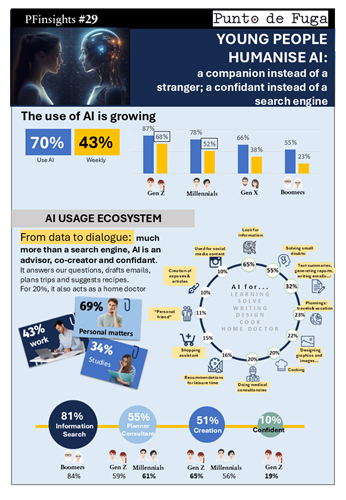
The relationship with Artificial Intelligence (AI) is evolving at breakneck speed. What was just a few years ago perceived as an experimental or distant tool is now becoming part of the daily routine of millions of people. According to data from our latest PFinsights#29 report, AI is already used by 70% of the population, with weekly usage reaching nearly 50% of the population.
The impact of AI is growing as users discover its usefulness in different areas of life, particularly among younger generations. Almost 9 out of 10 Millennials and Gen Zers are AI users, and these generations are driving a new way of relating to technology: closer, more emotional and more natural.
This surge in the use of artificial intelligence is transforming not only the ‘how much’ (we use it), but also the ‘how’ (we use it). AI is evolving into a new type of digital intermediary. AI is no longer limited to providing answers, but accompanies processes, shapes ideas and helps with decision-making. It is no longer used merely as a search engine; it is also a consultant, creator, planner and even a confidant. An application of AI that not only focuses on personal matters (69% of people use it for this purpose), but also extends to the workplace (43%) and the field of education (34%).

And although artificial intelligence continues to arouse a certain degree of mistrust – 7 out of 10 believe that one should not fully trust what AI says – direct experience is breaking down these barriers. Over half of users (55%) say that their perception of AI has improved with use and that it is more useful than they had expected. Familiarity breeds trust, and as usage grows, the relationship becomes more human.
This is clearly evident in the way that younger people, who are the heaviest users of AI, are humanising it. The relationship with AI changes drastically depending on age:
- For Boomers and Generation X, AI remains “a stranger”. Distance and caution persist, reinforced by a generalised mistrust.
- Among Millennials, a more habitual and practical use is beginning to take hold: AI is perceived as a “companion” that makes tasks easier.
- And for Generation Z, the relationship becomes clearly emotional. One in five young people describe it as a friend, and 40% as a close companion. This shows a profound transformation in the way this generation connects with technology, in terms of both how much and how.
Whenever a transformative technology emerges, a divide arises between those who embrace it enthusiastically and those who reject or distrust it. This is precisely what is happening with AI: its ‘lovers’ are the youngest generation, who are transforming its use from a search engine into a functional assistant. It is a new companion that combines utility, creativity, emotion and support. The way in which each generation adopts AI reflects a historic transition: from technology as a tool to technology as a relationship.
If you’d like to find out more, download our new #PFinsight!


